



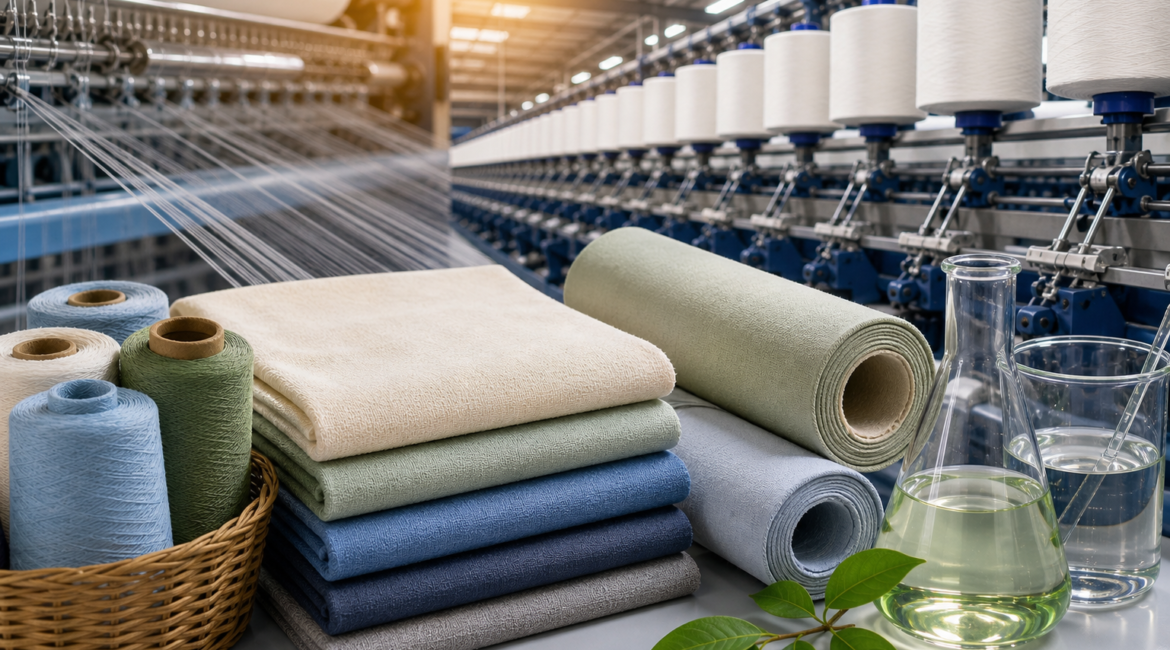
In textile manufacturing, fabric quality begins long before the finished material reaches the customer. Yarn preparation, weaving, and finishing all play an important role in determining the final result. Along the way, the right chemical solutions can help manufacturers achieve consistent processing and the desired fabric characteristics.
Today, businesses exploring textile chemicals in India are looking for products that support yarn performance, improve process consistency, and meet changing quality and sustainability expectations.
But how exactly do textile chemicals influence yarn and fabric quality? And what should manufacturers consider when choosing the right solutions?
Let’s explore the key stages where chemical selection can make a difference.
What Are Textile Chemicals and Why Do They Matter?
Textile chemicals are products used for specific purposes during textile manufacturing and processing. Depending on the application, they can help prepare yarn, support weaving, provide binding properties, or achieve a desired fabric feel.
Their role depends on the chemical formulation, material, application method, and operating conditions.
For textile manufacturers, choosing a suitable chemical can help support:
- Consistent yarn performance during weaving
- Desired fabric softness and handle
- More predictable processing results
- Better compatibility between materials and chemicals
- Efficient use of production resources
However, chemicals cannot compensate for every machinery, yarn, or process problem. Product selection and application conditions must be considered together.
1. How Textile Sizing Chemicals Influence Yarn Performance
Yarn must withstand repeated movement and friction during weaving. Warp yarn, in particular, experiences mechanical stress as it passes through the loom.
Textile sizing chemicals are applied during warp yarn preparation to help improve yarn performance under suitable processing conditions.
Supporting Yarn Strength and Abrasion Resistance
A suitable sizing system can help improve resistance to abrasion and support the yarn as it moves through the weaving process. The results depend on the yarn type, sizing formulation, application conditions, and loom requirements.
Choosing an unsuitable sizing chemical or applying it incorrectly may contribute to processing difficulties.
Helping Reduce Weaving Interruptions
Yarn breakage can interrupt production and increase the need for operator intervention. Appropriate sizing selection may help support smoother weaving, although yarn quality, machine settings, humidity, and other factors also influence breakage.
Manufacturers should evaluate sizing products under their actual production conditions rather than relying on product descriptions alone.
2. How Textile Chemicals Influence Fabric Quality
Fabric quality involves more than appearance. Buyers may evaluate softness, uniformity, durability, handle, and suitability for the intended application.
Textile chemicals can contribute to specific fabric characteristics when selected and applied appropriately.
Achieving the Desired Fabric Feel with Textile Softeners
Textile softeners are used to help achieve the desired softness and handle in suitable fabric applications.
The right product depends on fabric composition, finishing requirements, compatibility, and the expected end use.
Manufacturers should test the selected softener to determine whether it delivers the required feel without creating unwanted changes to other fabric properties.
Using Textile Binders for Specific Applications
Textile binders provide binding properties in applications where they are required. Their suitability depends on the substrate, formulation, application method, and performance expectations.
Choosing an appropriate binder requires a clear understanding of the intended use and relevant technical specifications.
Maintaining Consistent Results
Chemical selection, dosage, application conditions, and compatibility can all influence processing outcomes.
A consistent approach to product selection and process control helps manufacturers assess whether a chemical is contributing to the required quality standards.
3. Why Chemical Compatibility Matters in Textile Manufacturing
Not every chemical works equally well with every yarn, fabric, or manufacturing process.
Incompatible products or unsuitable application conditions can contribute to uneven results, processing difficulties, or additional rework.
Before introducing a new textile chemical, manufacturers should consider:
- Yarn and fabric composition
- Existing chemicals used in the process
- Machinery and operating conditions
- Product specifications
- Recommended dosage and application method
- Desired fabric characteristics
Small-scale trials and technical discussions with suppliers can help identify potential issues before full-scale production.
For businesses comparing textile chemicals in India, compatibility should be part of the selection process—not an afterthought.
4. How to Choose the Right Textile Chemicals in India
Selecting the right product begins with understanding the manufacturing requirement. A chemical suitable for one application may not deliver the same results in another.
Here are some practical steps textile mills can follow.
Identify the Manufacturing Challenge
Determine whether the main requirement relates to yarn performance, weaving, fabric softness, binding, or another application-specific need.
A clearly defined requirement makes it easier to evaluate suitable products.
Review Technical Documentation
Ask the supplier for relevant Technical Data Sheets (TDS), Safety Data Sheets (SDS), product specifications, and application guidance.
These documents help technical and procurement teams understand product characteristics, handling requirements, and recommended use.
Conduct Appropriate Product Trials
Where possible, evaluate the product under suitable manufacturing conditions before purchasing in large quantities.
Compare the results against clearly defined production and quality requirements.
Evaluate Supplier Support
A supplier who provides clear technical information can help manufacturers understand product suitability and make informed purchasing decisions.
Consider product consistency, communication, supply arrangements, and available technical assistance alongside price.
5. The Role of REACH-Compliant Textile Chemicals
For manufacturers supplying international markets, chemical compliance may be an important part of customer and supply-chain requirements.
REACH-compliant textile chemicals are relevant where the European Union’s REACH regulation applies to the product and supply chain.
Manufacturers should request product-specific documentation and verify the requirements relevant to their circumstances. A general claim about a supplier does not automatically establish that every product meets every applicable regulatory obligation.
When assessing a supplier, check:
- Relevant product declarations
- Safety Data Sheets
- Technical specifications
- Restricted-substance requirements applicable to the product
- Customer-specific compliance expectations
Careful verification helps manufacturers make better-informed decisions and maintain appropriate documentation.
6. Eco-Friendly Textile Chemicals: Performance and Sustainability
Sustainability is an increasingly important consideration in textile production. However, selecting a chemical based only on an “eco-friendly” label may not provide enough information.
When evaluating eco-friendly textile chemicals, manufacturers should look at the evidence behind environmental claims and consider the product’s actual use.
Important factors include:
- Product composition and safety information
- Biodegradability data, where applicable
- Relevant environmental certifications or declarations
- Chemical consumption during application
- Compatibility with the existing process
- Effects on fabric quality and production efficiency
A product’s environmental profile should be assessed using suitable evidence. Terms such as “biodegradable,” “eco-friendly,” and “sustainable” are not interchangeable and should not be treated as proof of identical environmental performance.
The goal is to find a solution that meets technical requirements while supporting clearly defined sustainability objectives.
7. Textile Chemical Industry Trends Affecting Manufacturers
Several developments are influencing how manufacturers evaluate textile chemicals.
Greater Attention to Product Documentation
Manufacturers and buyers increasingly need clear technical information to assess chemical suitability and meet applicable customer requirements.
Focus on Process Consistency
Textile mills continue to look for solutions that help maintain predictable results and reduce avoidable production interruptions.
Growing Interest in Sustainability
Businesses are paying closer attention to environmental claims, chemical management, and the evidence supporting sustainability-related product information.
More Careful Supplier Evaluation
Instead of comparing products only by price, buyers can assess technical support, product specifications, supply reliability, and overall application value.
These textile chemical industry trends make informed product selection important for manufacturers seeking dependable production outcomes.
8. Common Mistakes to Avoid When Selecting Textile Chemicals
Even an appropriate product may deliver disappointing results if it is selected or applied without considering the manufacturing process.
Avoid these common mistakes:
- Choosing a chemical based only on price
- Assuming the same product suits every yarn or fabric
- Ignoring product specifications and safety documentation
- Skipping suitable trials before bulk adoption
- Accepting sustainability claims without supporting evidence
- Overlooking compatibility with existing chemicals
- Assuming compliance claims apply to every product in a supplier’s range
A structured selection process can help reduce uncertainty and support more consistent manufacturing decisions.
Why Consider Sri Gomuki Tex Chem Pvt Ltd?
Sri Gomuki Tex Chem Pvt Ltd provides textile chemical solutions for modern textile manufacturing, with a focus on textile sizing chemicals, binders, and softeners.
For textile mills and manufacturers, selecting the right product involves understanding the application, reviewing technical information, and assessing whether the solution meets specific production requirements.
Frequently Asked Questions
Depending on the application, textile chemicals such as sizing products can help support warp yarn performance and abrasion resistance during weaving. Results depend on the yarn, formulation, application conditions, and machinery.
Textile chemicals can contribute to characteristics such as softness, handle, and binding performance. Their effect depends on the product, fabric type, application method, and process conditions.
Common categories include textile sizing chemicals, binders, and softeners, along with other application-specific products used according to manufacturing needs.
Compatibility helps determine whether a product is suitable for the materials, other chemicals, machinery, and conditions involved in a process. Unsuitable combinations may cause processing difficulties or inconsistent results.
Manufacturers should assess product suitability, technical documentation, quality consistency, supplier support, compliance requirements, sustainability information, and overall value.
No. “Eco-friendly” and “biodegradable” describe different characteristics. Manufacturers should check product-specific evidence and avoid assuming that one claim proves the other.
Conclusion
The right chemical selection can contribute to yarn performance, weaving efficiency, fabric feel, and consistent processing. However, results depend on the product, material, application method, and manufacturing conditions.
For businesses sourcing textile chemicals in India, a careful evaluation of product suitability, compatibility, documentation, and supplier support is essential.
By combining technical evaluation with appropriate trials and process control, textile manufacturers can make informed choices that support both product quality and production requirements.
Looking for textile chemical solutions for your manufacturing process?
Call Now: +91 9655006383
Sri Gomuki Tex Chem Pvt Ltd — Think Sustainability. Choose Gomuki.